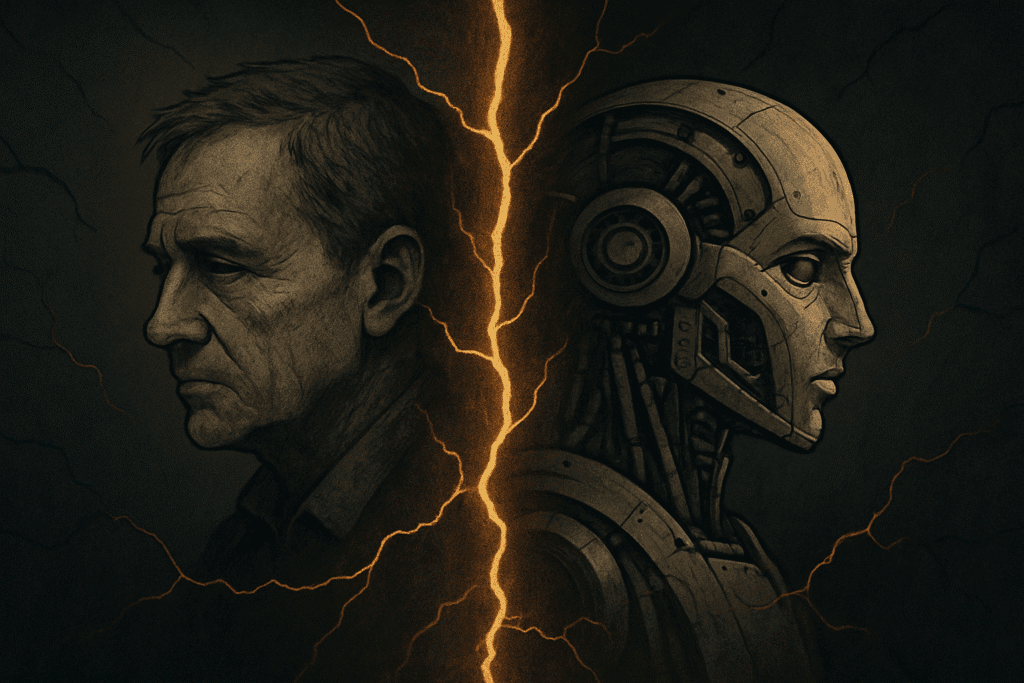
Can You Prove Post-WWII Capitalism Survives?

A thesis that cannot be tested is dogma. This challenge is designed to break the Discontinuity Thesis V3.2 – the framework that has evolved under adversarial fire.

The Prize: £250 + £250 referral bonus. If you can’t do it but someone you know can, point them here and if they solve the challenge, they get £250 and can specify who referred them for another £250.

The challenge is tough and probably unbeatable, but that is a reflection of real life.

From above of chaotic pile of dollar banknotes and euro cash

The Discontinuity Prize:£250
What the Thesis Claims

Post-WWII capitalism dies. The economic system characterized by mass productive employment, wage-based purchasing power, upward mobility through cognitive work, and democratic participation via economic citizenship becomes structurally impossible under AI-driven automation.

This is not speculation about what replaces it. This is a diagnostic claim that a specific economic system cannot survive current technological forces.


How to Win the Prize

To falsify the thesis, show ALL of the following simultaneously:

Cognitive Ladder Restoration: New cognitive work categories that are AI-resistant, wage-sustaining ($40k+ annually), scalable to millions, and productive (creating value, not redistributing it).

Mass Productive Participation: 50%+ of working-age adults can obtain employment that requires human capabilities economically superior to AI, creates genuine value, cannot be arbitraged away, and emerges from competitive market forces rather than regulatory mandate.

Coordination Solution: The Multiplayer Prisoner’s Dilemma can be solved through binding international agreements with enforcement mechanisms that prevent competitive defection. You must also solve the Sorites paradox, to establish the line between augmentation and replacement for billions of fractal prisoners dilemmas from countries, companies and individuals every day.

Democratic Economic Agency: Political democracy can function when 50%+ depend on transfers rather than productive employment while economic value concentrates in AI systems controlled by <5%.


What Will Not Count

Capital Redistribution Schemes: UBI, AI dividend funds, or wealth transfers constitute system replacement, not survival. They preserve consumption while eliminating productive participation.

Other Invalid Approaches: Temporary refuges, speculation about unknown job categories, historical analogies without addressing AI’s cognitive automation, or regulatory solutions ignoring competitive arbitrage.

The Test: You must show mass productive employment persists, not just alternative income sources.

Anti‑Lawyer Clause (Spirit Guardrail)

If a submission satisfies the letter of the rules but only by:

  • Re-labeling make‑work or legally protected placeholders as “market demand,”
  • Replacing competitive wage allocation with de facto state payrolls/quotas, or
  • Redefining “post‑WWII capitalism” (e.g., >80% public employment, price signals sidelined),

then it fails.

Judge obligation: Any rejection under this clause must (a) cite the specific clause(s) breached, and (b) show, in ≤200 words, how the proposal functionally abandons competitive wage determination rather than preserving it. No vague “vibes” rulings.


The Challenge Process

The Oracle: Custom GPT trained on V3.2. Engage it and force a formal concession. [Access here]

Manual Check: I verify whether the thesis was legitimately defeated or the bot was worn down. Analysis provided for your submission.

The Judge: LLM reviews conceded cases, distinguishing between thesis defeat (legitimate falsification) and bot defeat (conversational manipulation).

Submission: Submit complete Oracle conversation via form below.


The Burden of Proof

The null hypothesis is no longer “everything will be fine.”

If you believe post-WWII capitalism survives AI automation, you must show how mass productive employment and economic citizenship through labor persist under technological pressure.

Until then, the death certificate stands.

Some people say the rules are rigged so it can’t be won, which may be true. But the rules reflect real life and how what challenges must be overcome to maintain the system. There are no rules there that are artificial.


Total Prize Pool: £500 • First valid falsification winsFramework Version: 3.2

The original The Discontinuity Thesis

For decades, economists and technologists have deployed the same reassuring narrative whenever new technology threatens existing jobs: “This time isn’t different. Every technological revolution has displaced workers temporarily, but ultimately created more jobs than it destroyed. The printing press, the steam engine, computers – people always panic, but human adaptability prevails.”

This narrative has become so entrenched that questioning it seems almost heretical. Yet the emergence of artificial intelligence demands we abandon this comforting historical framework entirely. We are not witnessing another incremental technological shift within capitalism. We are witnessing capitalism’s termination as a viable economic system.

This is the Discontinuity Thesis: AI represents a fundamental break from all previous technological revolutions. Historical analogies are not just inadequate – they are categorically invalid for analysing this transition.

https://youtube.com/watch?v=pXit0SIcMvc%3Ffeature%3Doembed

The P vs NP Inversion

To understand why this time is different, we must examine what AI actually does to the structure of knowledge work. Computer scientists classify some problems into two categories: P problems (easy to solve) and NP problems (hard to solve but easy to verify). Finding a university course schedule with no conflicts is NP – extremely difficult to create. But checking whether a proposed schedule actually works is P – relatively simple verification.

For centuries, human economic value was built on our ability to solve hard problems. Lawyers crafted legal strategies, analysts built financial models, doctors diagnosed complex cases, engineers designed systems. These were NP problems – difficult creative and analytical work that commanded high wages.

AI has inverted this completely. What used to be hard to solve (NP) is now trivial for machines. What remains is verification (P) – checking whether AI output is actually good. But verification, while easier than creation, still requires genuine expertise. Not everyone can spot when an AI-generated legal brief contains flawed reasoning or when a financial model makes unfounded assumptions.

This creates what we might call the Verification Divide. A small percentage of workers can effectively verify AI output and capture the remaining value. The vast majority cannot, rendering them economically obsolete. The market bifurcates between elite verifiers and everyone else.

Why Historical Analogies Fail

Previous technological revolutions automated physical labour and routine cognitive tasks while leaving human judgment and creativity as refuges. Factory workers became machine operators. Accountants moved from manual calculation to computer-assisted analysis. The pattern was always the same: technology eliminated the routine, humans moved up the value chain to more complex work.

AI breaks this pattern by automating cognition itself. There is nowhere left to retreat. When machines can write, reason, create, and analyze better than humans, the fundamental assumption underlying our economic system, that human cognitive labor retains lasting value – collapses.

The steam engine replaced human muscle power but created new jobs operating steam-powered machinery. AI replaces human brain power. What new jobs require neither muscle nor brain?

The False Optimisation

Recognising the inadequacy of historical analogies, some analysts propose what appears to be a more sophisticated model: perpetual adaptation. In this vision, humans become “surfers” riding waves of technological change, constantly learning new skills, orchestrating AI systems, and finding value in the gaps between AI capabilities.

This model is not optimistic. It is a more insidious form of dystopia that replaces clean obsolescence with chronic precarity.

The “surfer” metaphor reveals its own brutality. Surfers don’t own the ocean – platform owners do. All risk transfers to individuals while platforms capture value. “Learning velocity” becomes the key skill, but this is largely determined by biological factors like fluid intelligence and stress tolerance that are unevenly distributed. A hierarchy based on innate adaptation ability is more rigid than one based on learnable skills.

Most perniciously, this model demands that humans operate like software, constantly overwriting their skill stack. “Permanent entrepreneurship” is a euphemism for the systematic removal of all stability, predictability, and security. It’s the gig economy for the soul.

System-Level Collapse

The implications extend far beyond individual career disruption. Post-World War II capitalism depends on a specific economic circuit: mass employment provides both production and consumption, creating a virtuous cycle of growth. Workers earn wages, spend them on goods and services, driving demand that creates more jobs.

AI severs this circuit. You can have production without mass employment, but then who buys the products? The consumption base collapses. Democratic stability, which depends on a large comfortable middle class, becomes impossible when that middle class no longer has economic function.

We’re not experiencing technological adjustment within capitalism. We’re witnessing the emergence of a post-capitalist system whose contours we can barely perceive. Current institutions are designed for an economy of human cognitive labor have no framework for handling this transition.

The Zuckerberg Moment

Mark Zuckerberg recently announced Meta’s plan to fully automate advertising: AI will generate images, write copy, target audiences, optimize campaigns, and report results. Businesses need only connect their bank account and specify their objectives.

This eliminates entire industries overnight. Creative agencies, media planners, campaign managers, analytics teams – all become redundant. There’s no “someone using AI” in this model. There’s just AI, with businesses connecting directly to automated platforms.

This is the Discontinuity Thesis in action: not gradual change within existing systems, but the wholesale replacement of human cognitive labour with machine intelligence.

No Viable Exits

The standard counter-arguments collapse under examination:

“New job categories will emerge” – How many people do “AI trainers” and “robot therapists” actually employ? Even optimistic projections suggest thousands of jobs, not millions.

“Humans will focus on emotional work” – This is the “artisanal economy” fantasy. Some premium markets will exist, but not enough to employ hundreds of millions of displaced knowledge workers.

“Regulation will preserve jobs” – Global competition makes this impossible. Countries that handicap AI development lose economically and militarily.

“AI has limitations”- These limitations shrink monthly. Even if AI only displaces 80% of cognitive work, that still constitutes economic catastrophe.

The Mathematics of Obsolescence

We’re left with simple arithmetic: if machines can perform cognitive tasks better, faster, and cheaper than humans, and cognitive tasks formed the basis of our economic system, then that system must collapse. This isn’t speculation—it’s mathematical inevitability.

The only meaningful questions are temporal: How quickly will this unfold? What will replace capitalism? How much chaos will mark the transition?

The Discontinuity Thesis offers no solutions because the situation admits none within existing frameworks. We cannot “upskill” our way out of comprehensive cognitive obsolescence. We cannot “augment” our way to relevance when the augmentation itself becomes autonomous.

This isn’t pessimism – it’s recognition. The sooner we abandon comforting historical analogies and confront the genuine discontinuity we face, the sooner we might begin imagining what comes next. The old world is ending. The new one hasn’t yet been born. And in this interregnum, a great variety of morbid symptoms appear.

The symptoms are everywhere. We’re just afraid to call them what they are.

Evolution Under Alternative Continuity Attack

The v3.1 falsification framework contained a critical vulnerability: the phrase “equivalent mechanisms to wages” created an opening for capital-redistribution schemes that preserve consumption capacity while abandoning productive participation. This version closes that loophole by clarifying what constitutes genuine system survival versus cosmetic continuity.

1. Redefining System Death vs. Functional Replacement

Post-WWII Capitalism is not defined merely by mass consumption capacity—it is defined by mass productive participation. The system dies when the majority of adults cannot contribute economically valuable labor, regardless of whether alternative income streams exist.

Key Distinction:

  • System Survival: Mass productive participation where human effort creates economic value
  • Functional Replacement: Mass consumption maintained through redistributive mechanisms

A National AI Dividend Fund represents functional replacement, not system survival. It preserves the consumption side while severing the production side permanently.

2. Enhanced Falsification Conditions [FINAL]

This section has been expanded to incorporate the Boundary Collapse Clause, which addresses the claim that international coordination could preserve human economic relevance. Because AI erodes task boundaries continuously, no coordination regime can define or enforce ‘human-only zones.’

To falsify this framework, show ALL of the following simultaneously:

Cognitive Ladder Restoration

Show that new cognitive work categories can emerge that are:

  • AI-resistant for the foreseeable future (not just temporarily)
  • Wage-sustaining at middle-class levels ($40k+ annually)
  • Scalable to employ tens of millions
  • Productive (creating economic value, not just redistributing it)

Mass Productive Participation

Show that 50%+ of working-age adults can obtain employment that:

  • Requires human cognitive or physical capabilities that remain economically superior to AI alternatives
  • Provides genuine economic value creation (not makework or subsidized positions)
  • Offers pathways to skill development and wage advancement
  • Cannot be easily arbitraged away through jurisdictional competition

Coordination Solution

Show that the Multiplayer Prisoner’s Dilemma can be solved through:

  • Binding international agreements that prevent competitive defection
  • Enforcement mechanisms that cannot be circumvented through regulatory arbitrage
  • Sustainable political coalitions that resist capture by AI-owning elites
  • Economic incentives that make cooperation more profitable than defection
  • Stable Task Boundaries that can be clearly defined and enforced

The last condition is decisive. Unlike nuclear arms control, which dealt with discrete countable objects, AI erodes every boundary between “permitted augmentation” and “forbidden automation.” Spell-check becomes drafting; drafting becomes full composition; composition becomes decision-making. Each partial allowance becomes a staging ground for total substitution.

Because task categories blur continuously, no treaty can define durable “human-only zones.” Any coordination regime collapses not only under defection pressure (the Multiplayer Prisoner’s Dilemma) but under definitional incoherence. The impossibility of drawing and policing boundaries between human and machine work makes meaningful coordination structurally impossible.

Democratic Economic Agency

Show that political democracy can function when:

  • 50%+ of the population depends on redistributive transfers rather than productive employment
  • Economic value creation is concentrated in AI systems controlled by <5% of the population
  • The masses lack economic leverage to influence political outcomes
  • Traditional labor organizing becomes impossible due to employment scarcity

3. Why Capital Redistribution Fails the Test

The Productive Participation Requirement

A dividend system fails because it creates economic citizenship without economic agency. Recipients consume but do not produce. This is feudalism with better marketing.

The Coordination Impossibility

Any jurisdiction implementing significant AI taxation faces immediate competitive disadvantage. The MPPD ensures that:

  • Companies relocate to lower-tax jurisdictions
  • AI development concentrates in tax havens
  • Dividend-implementing regions become dependent on declining tax bases
  • The system collapses through competitive defection

The Capture Problem

The political economy assumption underlying dividend schemes—that AI-owning elites will voluntarily redistribute their rents—contradicts 40 years of evidence showing elite capture of democratic institutions.

The Arbitrage Reality

Unlike VAT (which taxes consumption and cannot be easily avoided), AI profit taxes can be circumvented through:

  • Transfer pricing manipulation
  • Offshore incorporation
  • Intellectual property licensing schemes
  • Jurisdictional arbitrage
  • Technical infrastructure relocation

4. The Mathematical Constraint

The thesis operates under mathematical, not political, constraints. Even perfect political will cannot overcome:

C1: Unit Cost Dominance AI + minimal human oversight achieves lower unit costs than human-only workflows across cognitive domains.

C2: Competitive Defection Any actor that fails to adopt cost-minimizing AI deployment loses market position to competitors who do.

C3: Coordination Failure No mechanism exists to enforce universal adoption of economically suboptimal (human-preserving) choices across all relevant actors.

Result: Mass cognitive unemployment occurs regardless of policy preferences.

5. Closing the Loophole: Survival vs. Replacement

The v3.1 vulnerability emerged from conflating system survival with outcome preservation. The corrected framework distinguishes:

System Survival Requires:

  • Mass productive employment at living wages
  • Human labor that creates genuine economic value
  • Sustainable competitive advantages for human workers
  • Democratic participation rooted in economic leverage

Outcome Preservation Accepts:

  • Alternative income sources (dividends, transfers, UBI)
  • Economic irrelevance of human labor
  • Concentration of productive capacity in AI systems
  • Political dependency on elite redistribution

Verdict: Capital redistribution schemes constitute replacement, not survival. They represent post-capitalist economic arrangements that may be superior to mass unemployment, but they are not continuations of the post-WWII system.

6. Implications for Transition Strategy

This framework shift has strategic implications:

For Policymakers: Stop trying to “save” the current system. Focus on managing the transition to whatever comes next.

For Workers: Develop skills in AI-resistant domains, but recognize that long-term security lies in capital ownership, not labor.

For Researchers: Study the political economy of transitions between economic systems, not the economics of system preservation.

For Civilization: Prepare for fundamental questions about human purpose, political organization, and resource distribution in a post-labor society.

7. Final Mathematical Formulation

P1: Cognitive Automation Dominance AI systems achieve cost and performance superiority across cognitive work, eliminating human competitive advantages.

P2: Coordination Impossibility No mechanism can enforce universal adoption of economically suboptimal (human-preserving) practices across competitive actors.

P3: Productive Participation Collapse The majority of humans cannot contribute economically valuable labor regardless of consumption-supporting mechanisms.

Result: Post-WWII capitalism dies. Alternative systems may emerge, but they constitute replacement, not survival.

8. Conclusion: Death Certificate Finalized

The age of mass productive employment ends with AI’s cognitive dominance. Alternative economic arrangements—dividend capitalism, UBI feudalism, techno-socialism—may provide superior outcomes for human welfare, but they are not capitalism’s survival.

They are its successors.

The Discontinuity Thesis documents a death, not a transformation. What emerges afterward is a separate question requiring separate analysis.

The patient is dead. The autopsy is complete. The cause of death: cognitive obsolescence in a competitive economy.

Time of death: When the last human worker becomes more expensive than their AI replacement.

The loophole is closed. The framework holds.

The last illusion to fall is the belief in stable boundaries. Some argue that coordination could preserve “human-only zones” the way nuclear treaties preserved deterrence. But AI does not respect categories. Spell-check becomes drafting, drafting becomes full composition, composition becomes decision-making. Each fragment automated makes the whole inevitable. Unlike missiles, tasks cannot be counted or frozen. Boundaries dissolve into gradients, and gradients slide into total substitution. There is nothing left to cordon off. The cage closes from the inside..

[THEORY TEXT]The Discontinuity Thesis argues for the collapse of Post-WWII capitalism due to Unit Cost Dominance (UCD).
DEFINITION: UCD is the economic condition where an AI + human verifier produces cognitive work at a significantly lower marginal cost than a human. In cognitive domains (bits, e.g., law), this leads to 50-100x cost reduction and mass REPLACEMENT. In physical domains (atoms, e.g., plumbing), it’s a 1.5-2x efficiency gain and AUGMENTATION. The marginal inference cost is all that matters. This model neutralizes common objections to AI, as the human verifier’s role is to correct for hallucinations and add the necessary human touch.
THE CORE MECHANISM:P1 (The Math): Competitive adoption is inevitable. The only refutation is to prove one of the following: verification costs don’t scale, AI quality gaps are permanent, markets will choose higher-cost humans, a binding global coordination is possible, or a massive physical job refuge exists.
P2 (The Trap): Coordination is impossible. It’s not one prisoner’s dilemma, but billions played out daily where the payoff matrix is simple: automate and achieve market dominance, or refuse and face economic death. Any actor not defecting is wiped out. This is compounded by the Sorites Paradox: the line between “assistance” and “replacement” is so blurry that most don’t even know they’re defecting until the system has already collapsed.
P3 (The Collapse & End of Participation): The wage-demand circuit that powers capitalism breaks. Production without wages means products without consumers. This is the collapse of productive participation. UBI is not a solution but management for a population without economic function or democratic agency—zoo animals in a curated enclosure.
DOWNSTREAM EFFECTS:1. THE DISSOLUTION: UCD dismantles the pillars of the post-WWII era: upward mobility (the cognitive ladder is gone), market-based wages (the floor is AI’s marginal cost), and democratic agency (economic leverage vanishes).

THE KNOWLEDGE TRAP: Knowing doesn’t help. Political tools were designed for the 20th-century problem of Capital vs. Labour. In the 21st century, Player 3 (the machine) has entered the game, and it only cares about Unit Cost Dominance.

THE PSYCHOLOGY (COS): Cognitive Obsolescence Syndrome is the accurate perception of this reality. Society victim-blames with futile “retraining” against an exponential curve.

THE POLITICS (SCAPEGOAT CYCLE): Political systems invent visible enemies (immigrants, China) to channel rage away from the invisible force of UCD.

Handy hint, you can actually just copy the page by using the button below and paste it into your favourite LLM and ask it to help you beat the challenge.

Likn to the oracle bot again.
https://chatgpt.com/g/g-684c73c9b29c8191b097b4a6267d59ac-discontinuity-thesis

Leave a Reply

Your email address will not be published. Required fields are marked *